

My time at Amazon: Part one
On status and sacrifice at Big Tech

When people ask me what it’s like to work at Amazon, I often tell them a line my husband heard shortly after we moved to Seattle.
He was at lunch when a coworker began running through Big Tech stereotypes.
“Microsoft is where you go to retire,” they said.
“What about here?” someone asked.
His coworker smiled, savoring the moment.
“Amazon is where overachievers go to feel bad about themselves.”
When I first heard the line, I laughed. I had never heard a sentence more accurately describe my husband. I assumed it would never apply to me. I wasn’t an overachiever. I was a self-taught designer from a state school, not the kind of person those companies hired.
While he threw himself into Amazon, I cycled through startups, each one slightly more chaotic than the last. These were places where “culture” meant Fireball shots and, once, a team‑building exercise that involved breaking a 2x4 with our bare hands. (“Visualize your hand moving through the board,” the emcee shouted.)
Then I had a baby.
And in the quiet clarity of new motherhood, I realized my thinking had been all wrong.
If I could create a human being, I reasoned, I could get a job in Big Tech.
Six months later, I did.
Day 1
It may sound silly, but the thing that surprised me about working at Amazon was just how big it was.
Of course, I knew this intellectually. It was April of 2019, and motherhood had turned me into someone who depended on multiple Amazon deliveries a day. But knowing it and experiencing it were two different things.
I felt the difference my first day.
I arrived for orientation and was surprised to see 250 other new hires.
“This is nothing,” I overheard an employee say. “During intern season, we do 2,000 a week.”
Despite the crowd, nothing felt chaotic. We were ushered through Disney World–style queues to take photos, submit paperwork, and pick up laptops. Every transition was anticipated. Every question already seemed to have a sign. We were funneled into a large, windowless room with the Amazon logo projected on the wall, where seasoned employees indoctrinated us into our new culture.
“We are customer obsessed,” they told us.
“We are peculiar,” which they defined as being willing to be misunderstood for long periods of time.
To test our comprehension, we took a quiz—
Question: What would you do if an engineer shipped a bug on Prime Day that changed the price of a TV from $2,000 to $2?
My answer: Apologize and ask if they still wanted it.
Correct answer: Honor the price. (Why? Because we are customer obsessed.)
I remember feeling surprised, then impressed. It was a way of thinking I hadn’t considered before. No startup I’d worked at could afford to.
After the quiz, the doors opened to reveal hundreds of shiny employee badges, alphabetically arranged.
As a user experience designer, I pay attention to where systems break. That day offered plenty of opportunities for things to go wrong. But nothing did. (Truly, the only bottleneck was the men’s bathroom line.)
And honestly? It felt magical. Not just because it was efficient, but because for the first time in my career, it felt like the adults were in charge. And they knew what they were doing.
Levels
I was hired to work on an analytics tool inside AWS, Amazon’s cloud division. During my first week, my boss walked me around to introduce me to the different teams. The relief on people’s faces made it clear my hire was overdue. There were around 300 employees, most of them engineers. I brought the total number of designers up to four.
“Where are you coming from?” people asked.
I told them the name of my previous company, well known in the Seattle tech scene. They just looked at me, blank.
“She’s an outside hire,” my boss clarified.
A few people nodded. Others smiled tightly and glanced at my boss.
Another question they asked, often directly to my boss, was simply:
“L6?”
This was my level at Amazon, and it would shape almost everything that followed.
Levels, explained
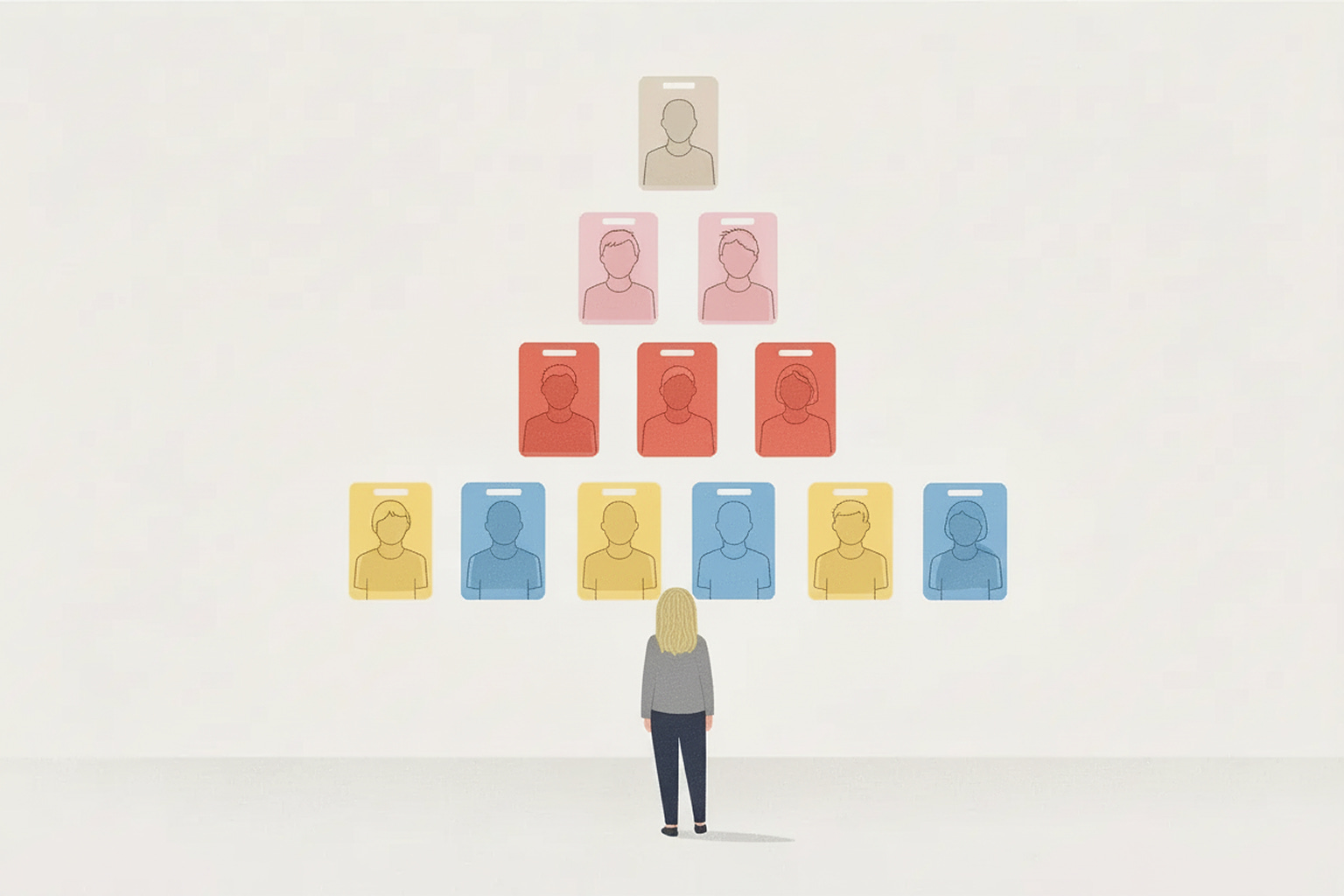
Every Amazon employee is assigned a number from 1 to 12 based on their perceived value to the company. There’s extensive documentation explaining what each level officially means. But this is how it felt inside:
There was only one level 12. At the time, it was Jeff Bezos.
11s ran massive divisions of the company. One ran Amazon.com. Another AWS. Back then, only one woman made it to this level and she was in charge of HR.
10s were essentially CEOs, running businesses like Amazon Fashion, Kindle, or EC2.
In practice, you dealt mostly with people one level above and below you. Which meant 10s worked with 11s and 8s.
Because there were no 9s.
8s directed everything.
7s absorbed the fallout.
6s got the work done.
5s were what Amazon was built on, but they asked a lot of questions.
4s were fresh out of college.
And I’m not sure what 1s through 3s did, but they didn’t work in corporate.
It may sound strange, even icky, to number people. But in a company this large, where churn was high, levels became a necessary shorthand.
They answered questions like:
How fast should I respond to this email?
Should I respond at all?
And why am I even on this thread?
Tenure
Levels were rarely spoken aloud, but always understood. Tenure, on the other hand, you could see.
Badge colors marked how long you’d been there in five‑year increments: blue, yellow, red, purple, and silver.
Taken together, levels and tenure let you size someone up instantly. Or be sized up just as fast.
A red badge who was still a 5, for example, was not a good sign, unless they’d worked their way up from the warehouse. Many people were suspicious of an L10 with a blue badge. Senior hires from outside often did not last. Amazon was too peculiar.
This is why my new coworkers were nervous.
It’s not that they wanted me to fail.
But they would understand if I did.
Status
Those first few months, I wanted to prove—to myself and to everyone there—that hiring me had not been a mistake. I was ready to Dive Deep, as the Leadership Principles say. But my boss onboarded me slowly.
“That time will come,” he said ominously.
At startups, I’d never had the luxury of ramping, so I took advantage of it. I took lunch breaks and coffee breaks. I invited coworkers along, who seemed surprised to be asked. People here tended to keep to themselves.
And I relished my newfound status.
Because the truth is, that’s why I wanted the job.
I hadn’t gone to a fancy university or worked at a name-brand company. I wanted to know what it felt like to have people immediately assume I was competent. Worthy.
Updating my LinkedIn felt like a redemption arc after years of not fitting in at business school. Old classmates resurfaced. Professors reached out to tell me they’d always believed in me.
But the only people who seemed impressed were outside Seattle, and often outside tech.
Still, I wore my blue badge like a Birkin bag, often “forgetting” to take it off at Trader Joe’s. I assumed people looked at me with awe—the way I once had.
Years later, I saw it differently.
Maybe some people were impressed.
But the ones who’d been there likely recognized something else. And maybe felt a little sorry for me.
Andy
About six months in, I stopped going out to lunch.
My boss told me he was going on paternity leave. In his absence, I’d be leading design for a top-secret project going in front of Andy Jassy, then the head of AWS.
We were sitting in a windowless conference room, sipping tea from identical black mugs.
“Opportunities like this don’t happen often,” he said. “If you can pitch Andy, get funding, and actually launch the product…”
He paused, satisfied.
“Now that’s how you become a 7.”
I hadn’t been thinking about promotion. From my husband, I knew it could take years. Often, it never happened at all.
But when someone hands you a blueprint, it’s hard not to imagine the house.
Meetings began appearing on my calendar. Weekly check-ins became twice a week. Then every day.
We were selling a vision: a new product for self-service analytics. To make it real, we needed dozens of engineers, millions of dollars, and approval to launch at the following year’s AWS conference in Vegas.
As the designer, I was responsible for shaping the narrative, thinking through the trickiest parts of the experience, and preparing a handout that walked through the future product.
Normally, I’m confident in my work because it’s grounded in user research. But this project was top secret. I couldn’t speak to a single customer.
Instead, I designed for Andy. Or rather, each person’s version of him. Everyone had an Andy story. He was spoken about like a minor deity. Brilliant. Capricious.
As the meeting approached, teams were quietly pulled in from Austin and New York. Priorities shifted overnight. It was both thrilling and unsettling how fast things could move when they mattered to the right person.
We rehearsed relentlessly. A PM played the role of Andy, interrupting me mid-sentence.
“What’s this?” he’d say, tapping on my screen.
“Oh—”
“Explain it.”
“Tha—”
“Now.”
It felt less like a design review and more like endurance training.
My life narrowed.
Each morning, I commuted in with my husband. Some days I never left the building, grabbing a late lunch from the sad café on floor two. At five, we rushed to pick up our daughter from daycare, popping ibuprofen on the way. Some nights, I didn’t realize my badge was still on until I was getting ready for bed.
I might have been reading Little Blue Truck to my daughter, but my mind was elsewhere, wondering whether Andy would prefer radio buttons or a dropdown on the second screen.
Bath time pulled me out of it. That’s when I noticed the bite marks on my daughter’s back.
“There’s a biter,” the daycare staff told me, careful not to use gendered pronouns. “They’re targeting the little ones.”
I was horrified. Helpless. I felt like I was failing her. But I pushed it down.
I told myself this is what a 7 would do.
Motherhood
By the time I started at Amazon, I already knew that motherhood would count against me if I let it.
I remember interviewing on the Seattle campus while I was still on maternity leave. I felt prepared, but I was nervous about the whiteboard exercise. I worried that when I stood up to draw boxes and arrows, my shirt might ride up and reveal the elastic waistband of my maternity pants and give me away.
I’d already slipped up.
At the beginning of the interview, my future boss made small talk.
“What do you like to do outside of work?” he asked.
“I like to take walks,” I said.
“Do you have a dog?” It was a completely reasonable question in Seattle, where dogs are everywhere and allowed in the office.
I paused, picturing my baby at home, curled in her stroller.
“No,” I said finally. “I have a baby.”
He looked surprised. He asked how old she was, and I instinctively padded her age by a couple of months—just enough to make it sound less raw, less new, less like a liability.
When he told me he had a kid too, it only made him more relatable.
When I joined, I kept photos off my desk. I avoided mentioning daycare logistics. I didn’t talk about sleep regressions or pediatrician appointments or the low-grade panic of being responsible for a very small person while trying to appear fully available to everything else.
And honestly, it wasn’t difficult. No one asked.
Slowly, I outsourced my life. Other people watched our daughter. Other people cleaned our house. Groceries and meals appeared on the porch.
I missed small things like choosing my own bananas, or lingering over lunch, but I didn’t have the time or energy.
I told myself it was temporary.
Just until the Andy meeting.
Which was now scheduled for next Tuesday at 3.
Then Thursday at 11.
Then Friday at 10.
The meeting
The day of the meeting, I was nervous but strangely calm. I’d already done everything I could. Months of work had been distilled into a six-page, single-spaced document and a supplemental handout I’d obsessed over for weeks.
I arrived early.
The conference room looked like every other conference room at Amazon—glass walls, whiteboards, long table—just larger, with bulletproof glass. As people filed in, I recognized faces I’d only ever seen in the company directory. They looked shinier in person.
I took a seat against the wall, behind my boss’s boss. The table filled, except for one chair in the middle.
Andy arrived late.
The meeting began the way these meetings always did: in silence. Everyone hunched over their printed copies of the six-page memo—the one we’d been editing until an hour earlier, sitting on the floor of a tiny office, stripping out every “wiggle word” we could find.
Twenty minutes passed.
Then Andy set his paper aside.
The 11s and 10s debated around him while he ate a Subway sandwich and scrolled on his BlackBerry, which somehow still existed.
Then he looked up.
“Who?”
The room snapped to attention.
He knew the details of our product better than I expected. He pushed on the tradeoffs until people revised themselves mid-sentence. When he made a joke, people laughed too quickly, too loudly, as if it had been rehearsed. The room reoriented around him.
Ninety minutes later, we had our funding.
I hadn’t said a word.
As people gathered their things, my boss’s boss handed me the stack of handouts I’d prepared.
“I guess we didn’t need these,” she said lightly.
On the way out, I dropped them into the recycling bin.
Vacation
The next day, we left for Maui.
I left my phone inside most of that trip, grateful to be free of it. We walked the beach early, before the crowds and the sharp midday sun. Our daughter found a set of measuring cups in the kitchen of our Airbnb and spent long stretches absorbed in them, perfectly content.
It was the first time in weeks I felt present, my mind quiet.
Or at least, quieter.
I kept thinking about the people in that room. The 10s and 11s who’d accomplished so much and held real power. And how none of them seemed settled. Everyone was still reaching for something just out of frame.
After the meeting, I’d gone out for drinks with the design team. We cheered to a job well done. My boss’s boss texted my boss to tell him to tell me, “Thanks.” It should have felt like a peak.
Instead, it felt oddly flat. As though I’d spent months sprinting toward something, only to realize I’d arrived at the starting line of another race.
One morning, standing on the beach, I turned to my husband.
“I get it,” I said.
“What’s that?”
“The appeal of Amazon.” The way it colonizes your mind. The way everything else gets pushed to the edges. The way it makes you feel important—right up until you get what you were chasing and realize it doesn’t feel like much at all.
He nodded, looking out at the water.
“It’s a drug,” he said.
Then he picked up his phone to check his email.
Return
When I returned from vacation, my boss had news.
“She’s bringing someone in,” he said.
He was getting a new boss. She was a 7, on the cusp of 8. But still, a 7.
“We’ll see how long my ego can handle this,” he said.
The new uber-7 arrived just as COVID shut down the campus. When everyone else seemed rattled, she appeared energized. She had a young child. I asked her how she managed it all.
“I have a stay-at-home husband,” she said cheerfully.
Seattle was the first U.S. city hit by the pandemic, traced to a senior living center just miles from us. My daughter’s daycare was inside one too. I pulled her out immediately.
Overnight, we had two Amazonians working from home and no childcare. Our cleaning lady returned to her family in California. I quarantined the mail and watched the scaffolding we’d built around our lives collapse.
Vest
There’s a date every Amazonian knows: their next vest.
As it approaches, people grow reflective. Conversations shift. You start asking yourself whether you can do this for another year, another six months, another vest, and what you’re willing to trade for it.
My next vest was a month away.
By then, the uber-7 had brought in half her old team. Quietly, the project that had been framed as my path to promotion was handed to someone else.
Work moved onto video calls. I watched myself all day in the corner of the screen, framed by the same living room background. Without offices, coffee breaks, or social distractions to soften it, there was only the job.
Was I really going to do this for another year? Another vest? In the middle of a global pandemic? With a small child?
The answer felt obvious.
A year and two days into my tenure, I quit.
Exit
My exit was unceremonious.
A recurring meeting repurposed as a send-off.
A prepaid FedEx box sent to my door for my laptop.
I stayed home with my daughter. Without the structure of meetings, the days began to blur. I worried about what I would say if someone asked what I did for work. But no one asked. No one talked to me at all.
I decided that if I did get asked, I would say, “I used to work at Amazon, but I quit.” I liked how it sounded.
I thought I was done with Amazon.
Two years later, I logged back in.
This is part one of a two-part essay. Read part two.
Much of this resonates. I just wrote my goodbye email to Amazon after almost 21 years. I left as an 8 who wanted 10 but realized it was more ego than anything and purposefully stepped back. Good luck - protect your personal time. I always took lunches, one small way I kept myself balanced.
'I'd arrived at the starting line of another race' - I feel this in my bones. I've spent over a decade in big tech and that feeling of achieving the thing and immediately sensing the next thing looming is so specific and so rarely named. Thank you for writing this.